Is your surfboard too small for you?
 Fin Selector: your fins in 1 minute
If you've put on weight or lost fitness since you got your board, or you went shorter and your surfing got worse, your board may be too small for you. Go up a size, be honest about your weight when you choose, and when you're torn between two sizes, take the bigger one.
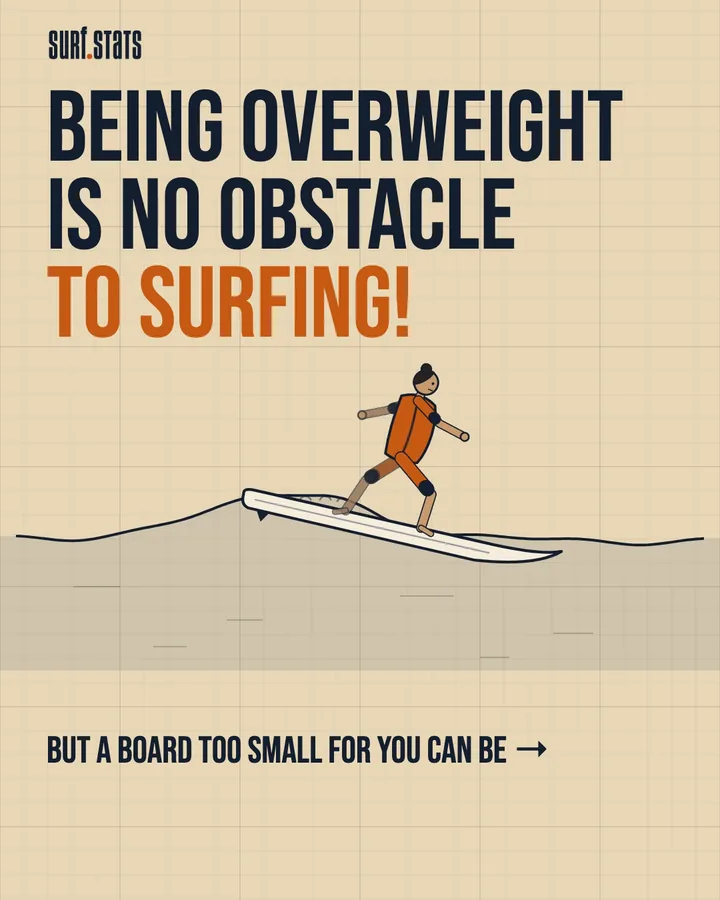
Being overweight is no obstacle to surfing. A board that's too small for you can be. Heavier surfers surf, pros included: the shaper Stab interviewed builds boards for bigger pro surfers and for bigger people in general. What gets in the way is the board under you.
Swellnet talked to a heavier surfer who started on boards that were too small for him and found it frustrating. The Inertia describes capable older surfers struggling to even catch a wave, not because their skills had faded, but because their boards were too small. Surf Simply sums up what a board that's too small does: it's slow to paddle and late into waves.
So is your surfboard too small for you? Below are four signs, and what to do about each one. They come from our is your board too small reel, built from surf coaches, a working shaper and surf magazines. One thing first: your body is never the problem here. The board is the thing you change.
1. Put on weight since you got your board?
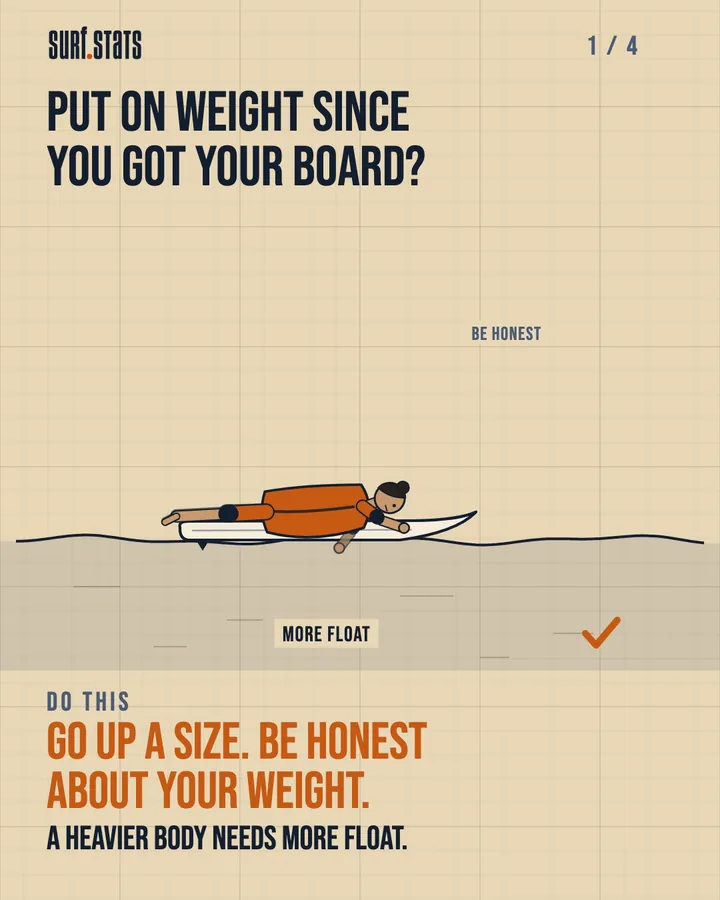
Try this: go up a size, and be honest about your weight when you choose.
A heavier body needs more float. Surf Simply explains it in terms of volume: a heavier surfer needs more of it to get the same buoyancy. The shaper Stab interviewed found the same thing on himself. He has put on weight, and he found he needed boards with more volume. Once, after time out of the water with an injury, he came back heavier and his usual board felt terrible. He moved up in size, and his surfing came back.
Less fit than you used to be? Same thing. Surf Simply says to find a volume that suits your fitness as well as your ability. The Inertia's piece on older surfers makes a similar point. A shaper in it says most surfers pop up a bit slower as they get older, and that for those who still want a shortboard, the answer is a larger one.
The honest part matters. That Stab shaper says bigger people often don't want to admit their size, and thinks a bit of ego is involved. The surfer Swellnet interviewed says you have to be honest about your ability, and sometimes your weight, when you look at volume. Choose for the weight you are today, not the one you'd rather say.
2. Think a smaller board means a better surfer?
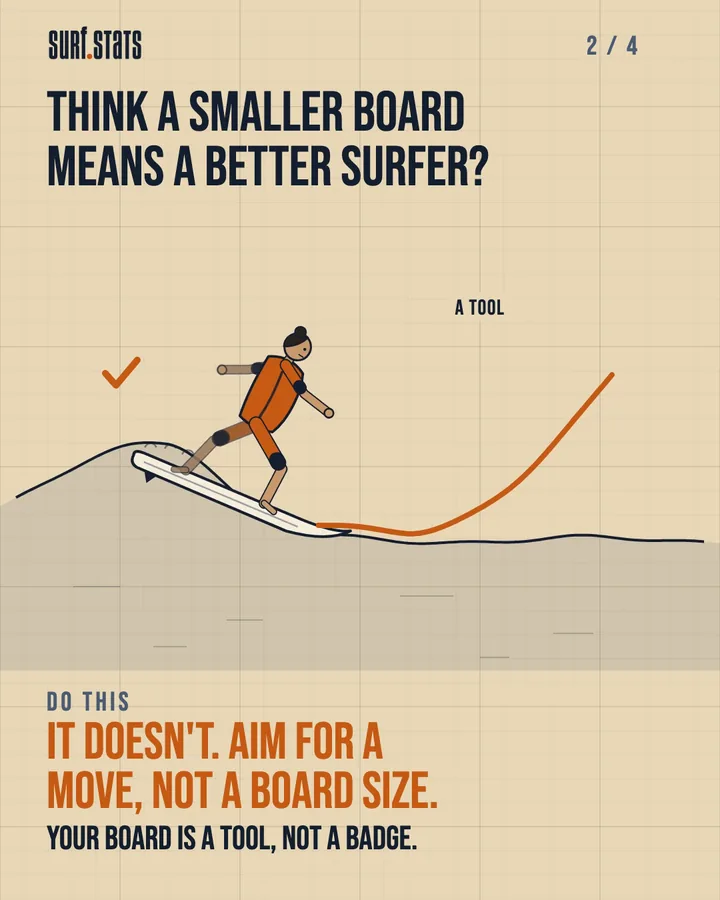
Try this: it doesn't. Make a move your goal, not a board size.
Your board is a tool, not a badge. Surf Simply calls "smaller board = better surfer" a misconception that has been around in surfing for decades, and says too many surfers treat a small board as a badge of their ability. OMBE, a surf coaching programme, warns against falling into the idea that every surfer should ride shorter boards.
A board that's too small makes good technique harder to learn. Surf Simply says a small board is easier to force bad technique on. OMBE says a shorter board amplifies bad movements. So set the goal the way OMBE suggests: decide what kind of surfing you're after first, then choose the board to match.
3. Went shorter, and your surfing got worse?
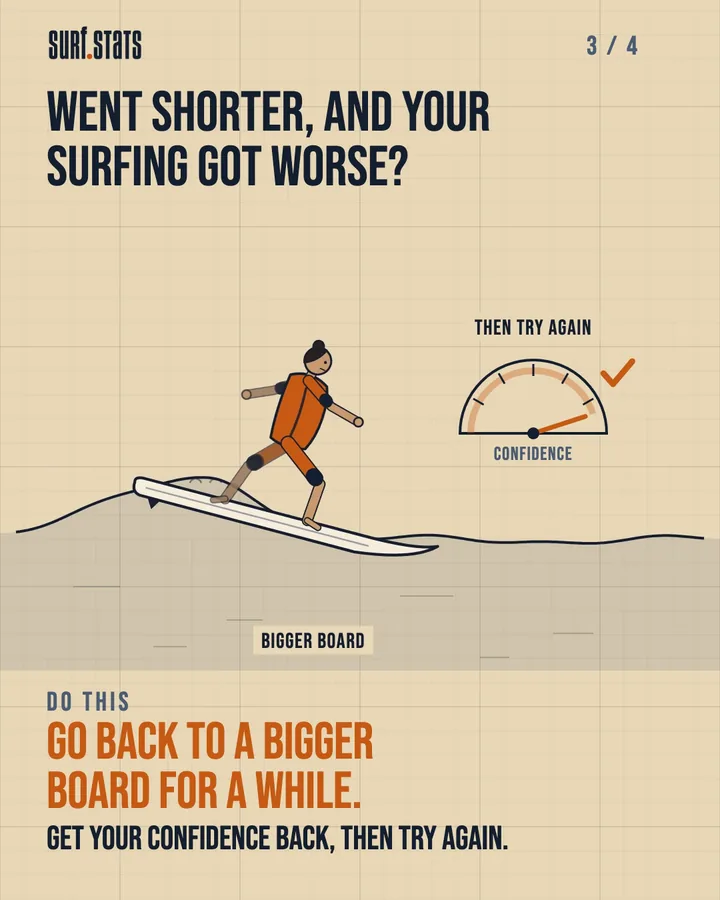
Try this: go back to a bigger board for a while.
Catch waves, have fun, and get your confidence back. Then try the shorter one again.
OMBE describes this exact spot. Someone moves down to a smaller board, and after a while it just isn't working: the pop-up gets worse and their technique suffers while they fight the board. Its advice is to go to a board you can build confidence on and have fun, and use it to reset the habit. How long you stay on it is up to you and your waves.
A writer at The Inertia says going from his smallest board back to his largest is a confidence boost, because everything gets a little easier. Then, when you've worked on your technique, OMBE says to move to the shorter board again.
4. Torn between two sizes?
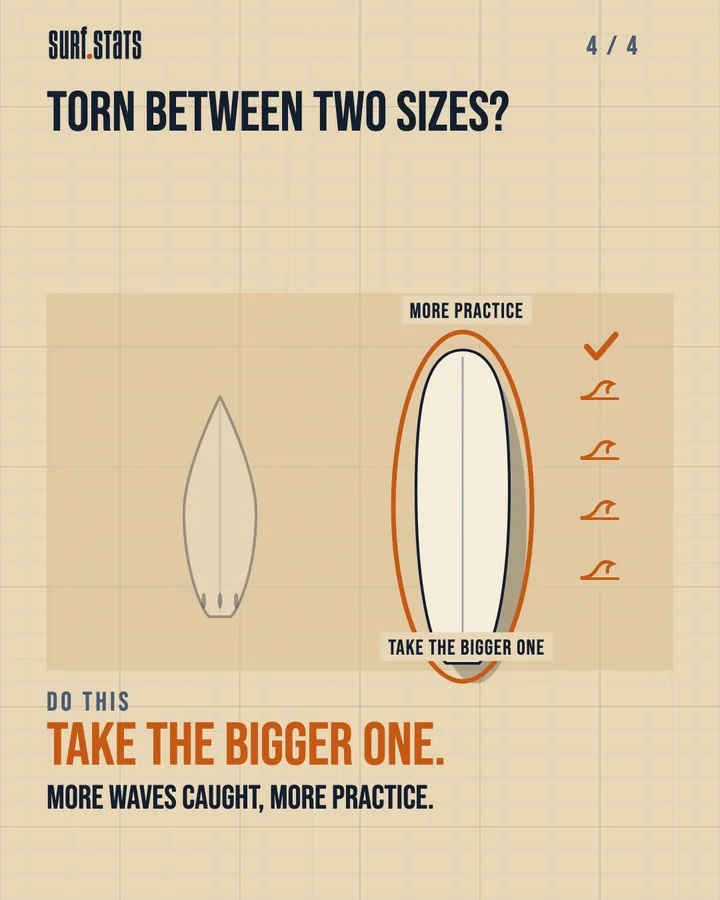
Try this: take the bigger one.
You'll catch more waves, and each wave you catch is practice. Surf Simply's advice when you're choosing between a few boards: take the bigger one, you won't regret it. A shaper quoted in The Inertia says the same thing: on a bigger board, you'll catch more waves.
More waves matter because you don't get that many in a session. Surf Simply points to the relatively low number of repetitions surfers get each time they paddle out. A surfer quoted in The Inertia puts it plainly: raising your wave count should be your main priority.
There is a trade. A bigger board turns slower than a smaller one. OMBE says to expect that, and to move with the board rather than force it.
A board for your body today
Choose a board for your body today, not for your pride. Not the board you rode before you got heavier or less fit, and not the board you think a better surfer would ride. If you keep missing waves, that's a different sign with its own fix, more volume, and it's in our guide on how to choose a surfboard.
Know someone on a board that's too small for them? Send them this.
Quick checklist
- Put on weight or lost fitness since you got your board? Go up a size.
- Tell the truth about your weight when you choose.
- A smaller board isn't a badge. Aim for a move, not a board size.
- Went shorter and got worse? Go back up for a while, then try again.
- Torn between two sizes? Take the bigger one.
- Expect a bigger board to turn slower, and move with it.