Shoulder exercises for surf paddling
 Fin Selector: your fins in 1 minute
Five slow moves work the back and shoulder muscles you paddle with: a prone Y raise, a prone T raise, an arms-back lift, a side-lying external rotation and a scapular push-up. Keep them pain-free and do the set about 3 times a week, with a rest day in between.
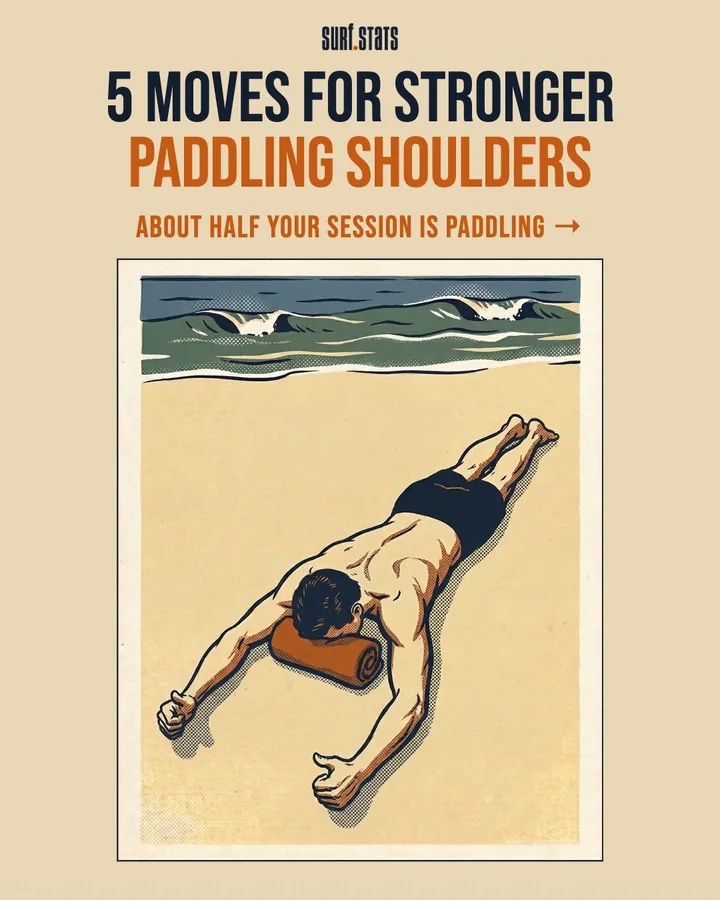
About half your surf session is paddling. That's what time-motion studies have measured, mostly in competitive surfers, and paddling is a back-and-shoulders job: your lats, your upper back and the backs of your shoulders do the pulling.
These five shoulder exercises for surfers work those muscles on land. No gear, just a towel and some sand or floor. They come from our 5 moves for stronger paddling shoulders reel, and each one is a move physios already use. Paddling technique is a different topic: for the stroke itself, read how to paddle a surfboard.
The method: squeeze, then lift
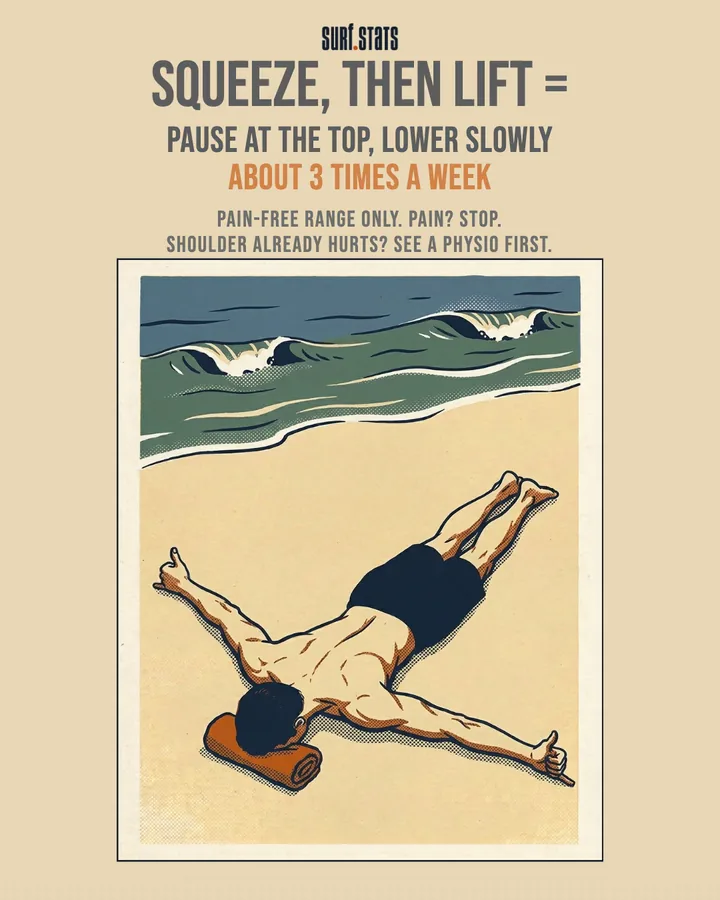
Try this: squeeze your shoulder blades first, then lift. Pause at the top, lower slowly.
The first three moves are done lying face down, and they share one method:
- Forehead on a rolled towel, neck long.
- Squeeze your shoulder blades back and down first, then lift your arms.
- Small, slow lifts, just off the sand.
- Shoulders down, away from your ears. Don't shrug.
- Lift with your shoulders, not your lower back.
- Pause at the top, then lower slowly. For the Y and the T, the American Council on Exercise suggests holding about 5 to 10 seconds.
Do the whole set about 3 times a week, with a rest day in between.
1. Prone Y raise
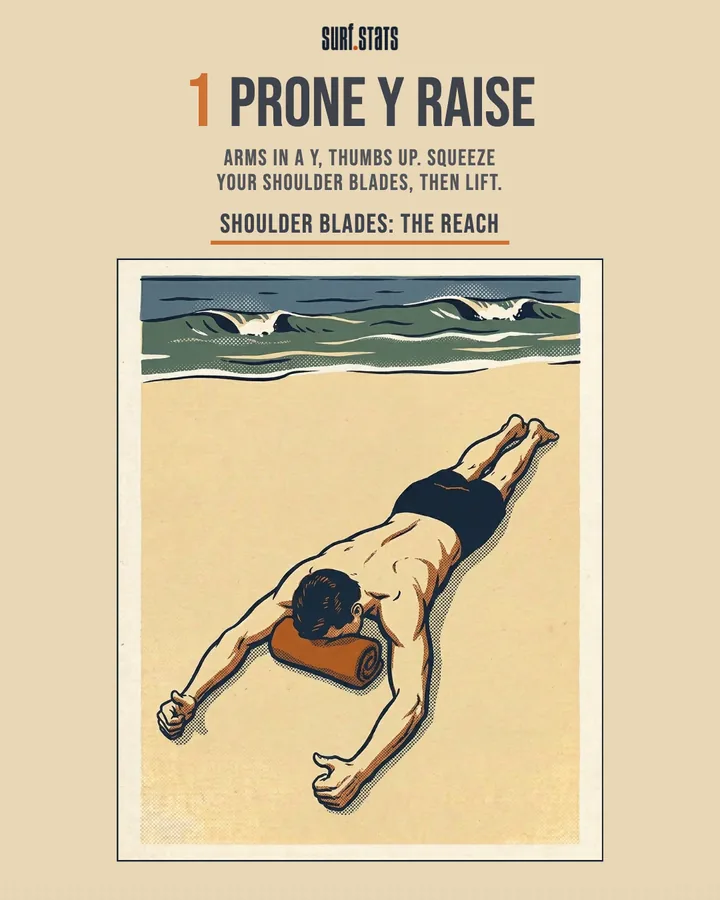
Try this: arms in a Y, thumbs up. Squeeze your shoulder blades, then lift.
Lie face down with your arms straight overhead in a Y, each arm angled out from your body, thumbs pointing to the sky. Squeeze your shoulder blades, lift both arms just off the sand, pause, and lower slowly.
Why it helps: every paddle stroke starts with your arm reaching forward. In a lab study of healthy adults (not surfers), this face-down overhead lift gave the highest lower trapezius activity of the exercises tested. Think of it as shoulder-blade work for the reach.
2. Prone T raise
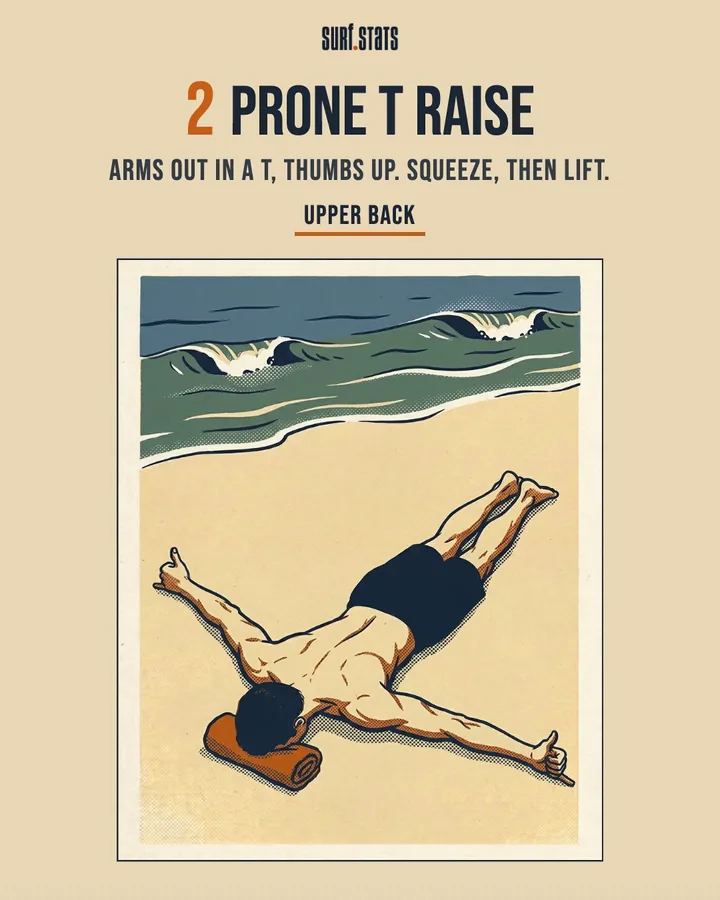
Try this: arms out in a T, thumbs up. Squeeze, then lift.
Same position, but now your arms go straight out to the sides at shoulder height, thumbs up. Squeeze your shoulder blades together, lift both arms just off the sand, pause, lower slowly.
This one targets your upper back, the muscles that pull your shoulder blades together, and the back of your shoulders. Your upper back works in every paddle stroke, and harder when you sprint (Nessler et al., Cal State San Marcos, 2019, a lab study of 12 recreational surfers).
3. Arms-back lift
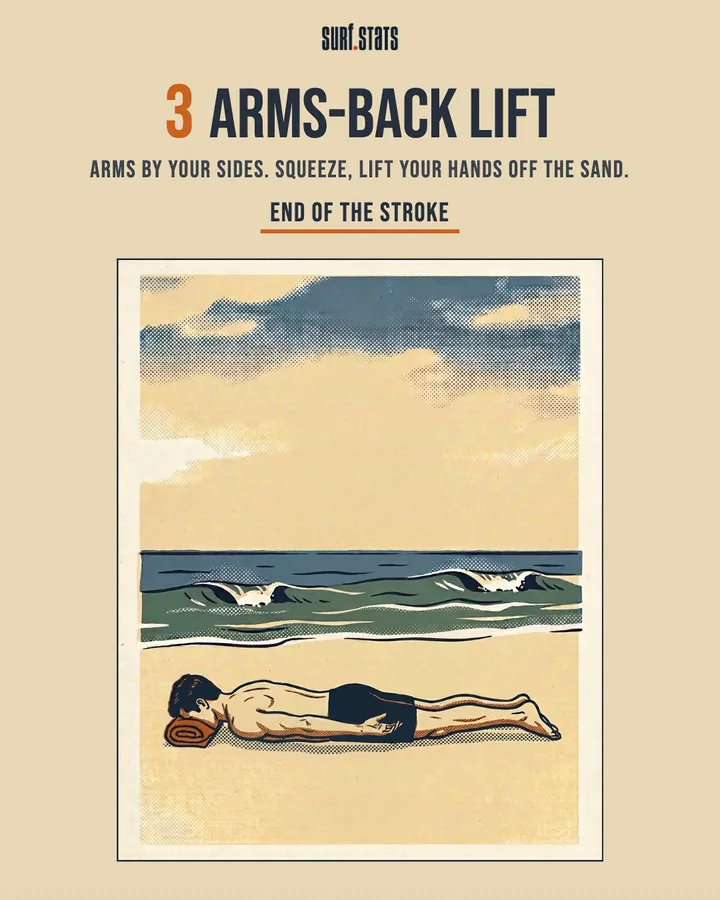
Try this: arms by your sides. Squeeze, lift your hands off the sand.
Lie face down with your arms straight along your sides, hands by your hips. Squeeze your shoulder blades and lift both hands off the sand behind you. Keep your chest and forehead down: only your arms lift. Pause, then lower slowly.
It works your upper back and the back of your shoulders. Your arm moves back toward your hip, the same way it goes at the end of your paddle stroke.
4. Side-lying external rotation
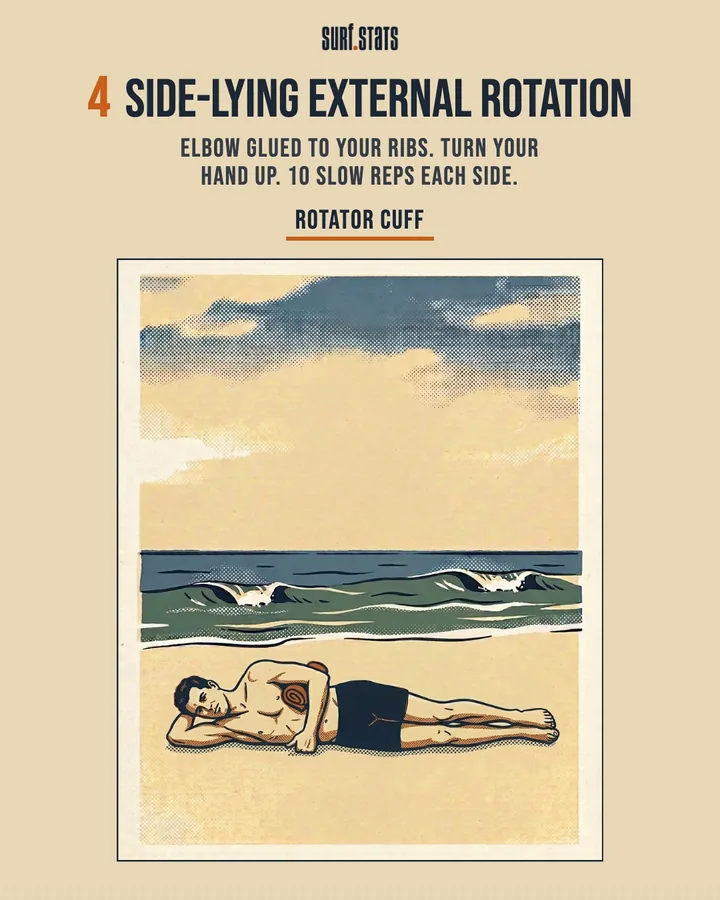
Try this: elbow glued to your ribs. Turn your hand up, slowly back down. 10 slow reps each side.
Lie on your side. Bend your top elbow to a right angle and keep it against your ribs, with a small rolled towel between the elbow and your side if you like. Start with your forearm resting across your belly, then turn your hand up toward the sky and slowly bring it back down. Don't let your body roll back.
Do 10 slow reps each side, 2 to 3 sets. Start with no weight.
Your rotator cuff is a group of small muscles that hold your shoulder in its socket. This move works the ones that turn your arm outward. Paddling turns your arm inward, stroke after stroke; this move turns it the other way.
5. Scapular push-up
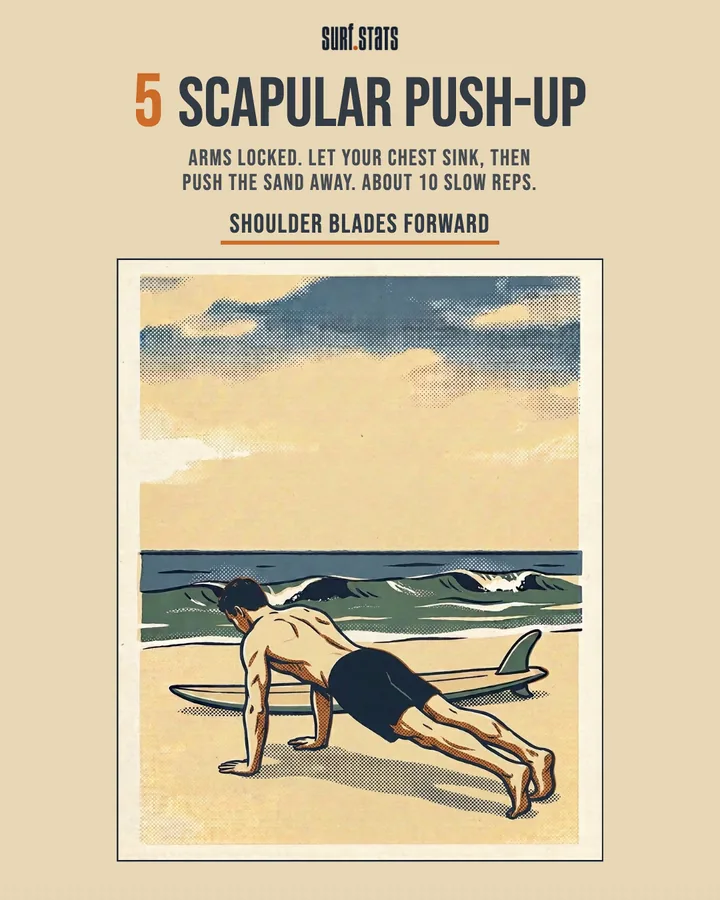
Try this: arms locked. Let your chest sink, then push the sand away. About 10 slow reps.
Get into a plank with your hands under your shoulders and your body in a straight line. Keep your arms straight the whole time: only your shoulder blades move. Let your chest sink so your shoulder blades slide together, then push the sand away so they move out and forward.
Too hard? Do it on all fours, arms still straight.
This one works the serratus anterior, the muscle that slides your shoulder blades forward.
What the research does and doesn't show
In studies of competitive surfers, stronger pulling went with faster sprint paddling (Edith Cowan University, 2012; Griffith University, 2025). Those surfers were tested on gym pull-ups, not these floor moves, and a study of 10 female surfers found no link between maximal pull-up strength and its paddling tests.
What these five do is work the muscles you paddle with, and physios use them. Paddling is also long, steady work, so your shoulders need stamina, not just strength.
Quick checklist
- Forehead on a towel. Squeeze your shoulder blades first, then lift.
- Small, slow lifts. Pause at the top, lower slowly.
- Y, T, arms back, rotation, push-up.
- 10 slow reps each side for the rotation, about 10 for the push-up.
- About 3 times a week, a rest day in between.
- Pain-free range only. Pain? Stop.