Single, twin, thruster or quad: which fin setup?
Single fin for long, smooth lines, twin for loose and fast, thruster for control in a wide range of waves, quad for speed down the line. Can't pick? A five-box board runs as a thruster or a quad.
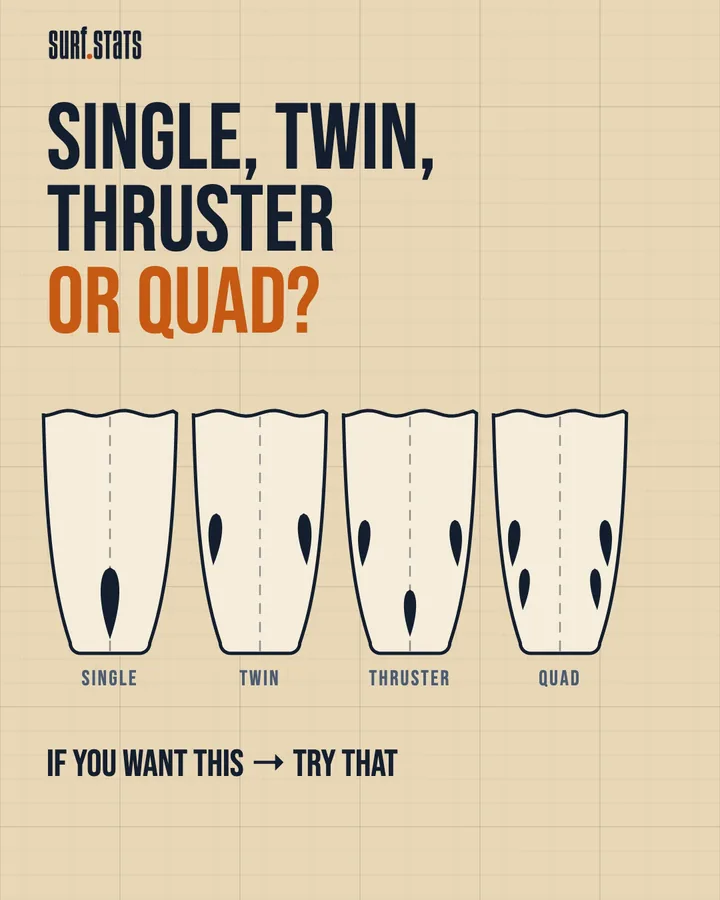
How many fins you ride, and where they sit, changes how a board feels. The four setups you will hear about are the single fin, the twin, the thruster and the quad, and a fifth option, a board with five fin boxes, lets you run two of them.
Below is one setup for each thing you might want from your board, from our single, twin, thruster or quad reel. Think of it as "if you want this, try that". The sources, surf media, shapers, fin makers and a surfing museum, agree on the broad feel of each setup and differ at the edges, so treat each line as a starting point, not a rule. Where a point rests on one named source, we name it. This post is only about how many fins you ride and where. Fin size, depth, base and rake are a different question, covered in how to choose your fins.
1. Want long, smooth lines? Try a single fin
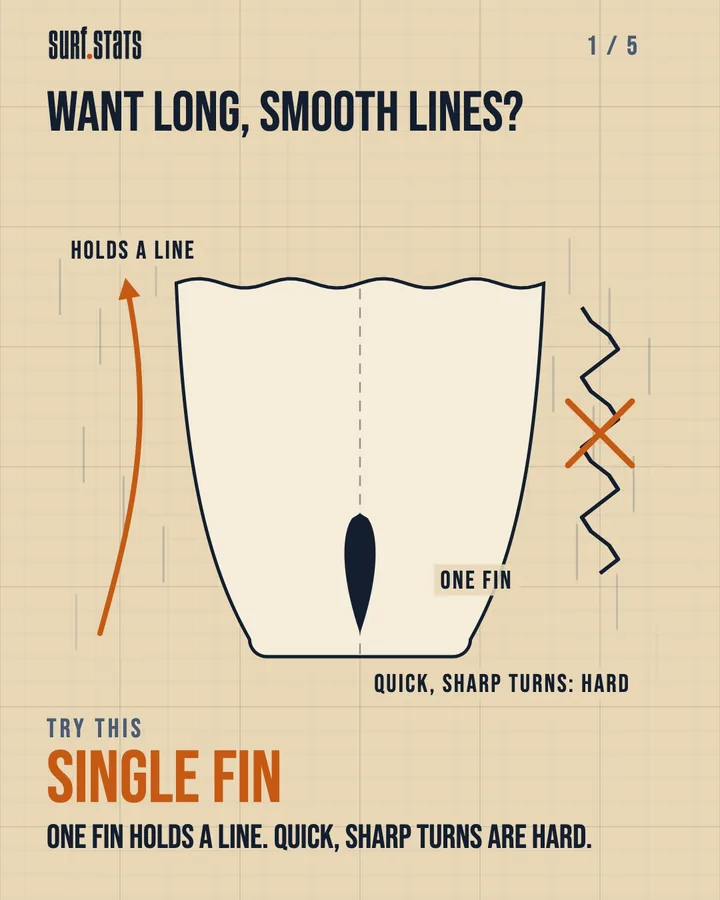
Try this: Single fin. One fin holds a line. Quick, sharp turns are hard.
The single fin is the original setup. Today you mostly see it on longboards. One long fin at the back of the board gives it a stable tail, which is why it is such a good option for holding a line and drawing out smooth turns on mellow waves.
The price is the other end of the same feel. Quick, sharp turns are hard on a single fin, so it favors smooth, drawn-out turns over tight ones.
2. Want loose and fast? Try a twin fin
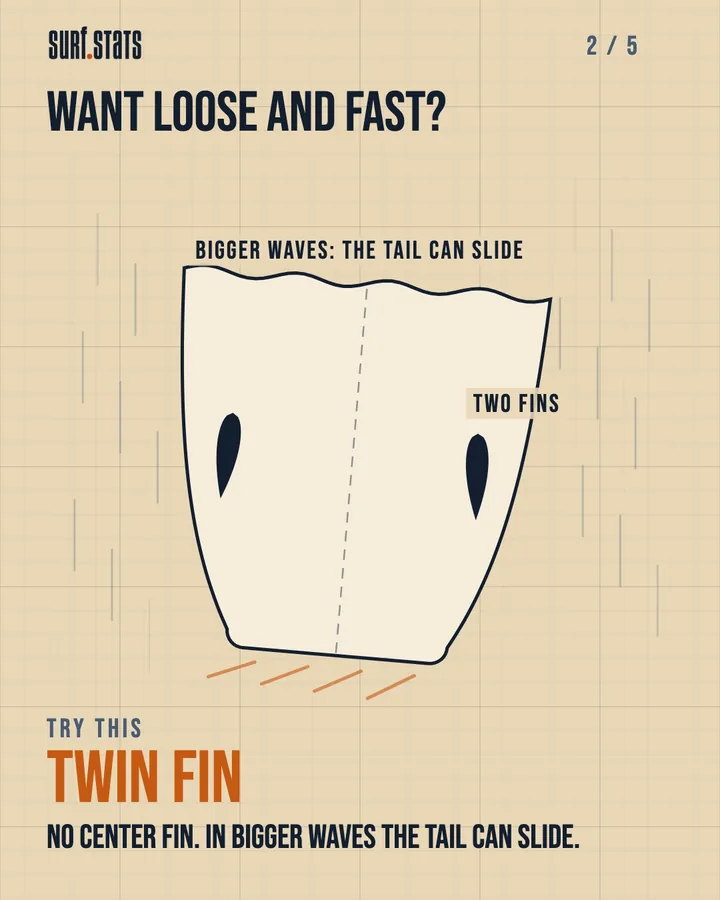
Try this: Twin fin. No center fin. In bigger waves the tail can slide.
A twin has two fins, one on each side of the tail, and no center fin. The sources describe it the same way: responsive, lively, fast, and fun even in smaller, weaker waves.
The catch is in bigger, steeper surf. Twins can be tough to control there, and the tail is prone to sliding out in bottom turns. That says "can", not "will", but it is the thing to know before you ride one in bigger waves.
3. Want control in a wide range of waves? Try a thruster
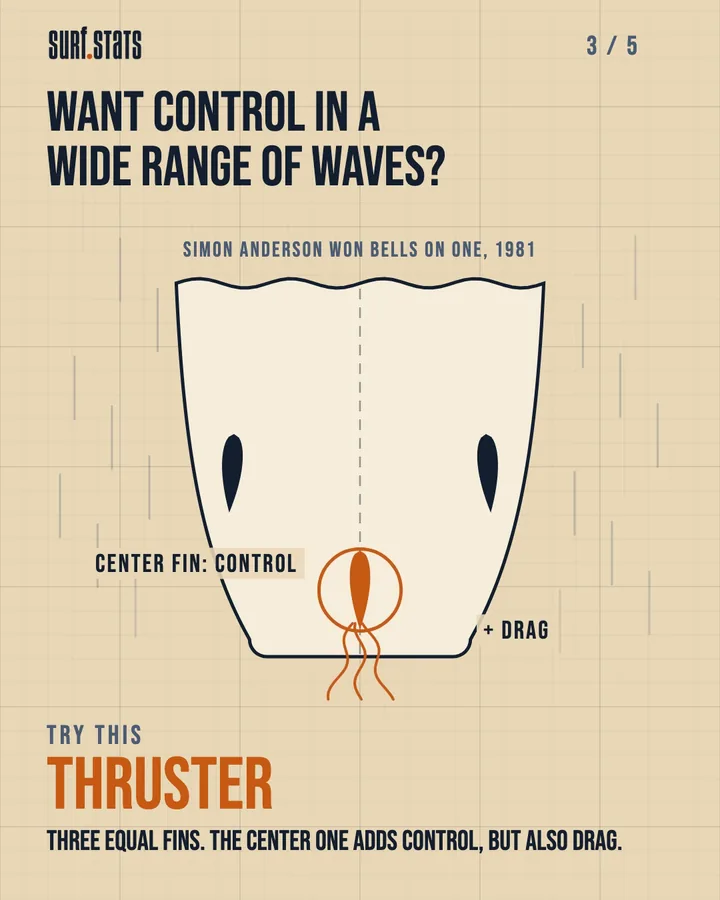
Try this: Thruster. Three equal fins. The center one adds control, but also drag.
A thruster is two side fins and a center fin set further back, all three the same size. FCS calls it a versatile setup that feels predictable, and Surfer Today says it adapts to a wide variety of boards and waves. Surfline's own take is that no single design does it all, but the thruster comes close.
Next to a twin, it is more stable and more forgiving, so you can push it harder without the tail sliding out. The cost is drag. The center fin trails behind the other two and cuts through the water, so some speed is sacrificed.
A bit of history: Simon Anderson won Bells Beach in 1981 on a three-fin board.
4. Want speed down the line? Try a quad
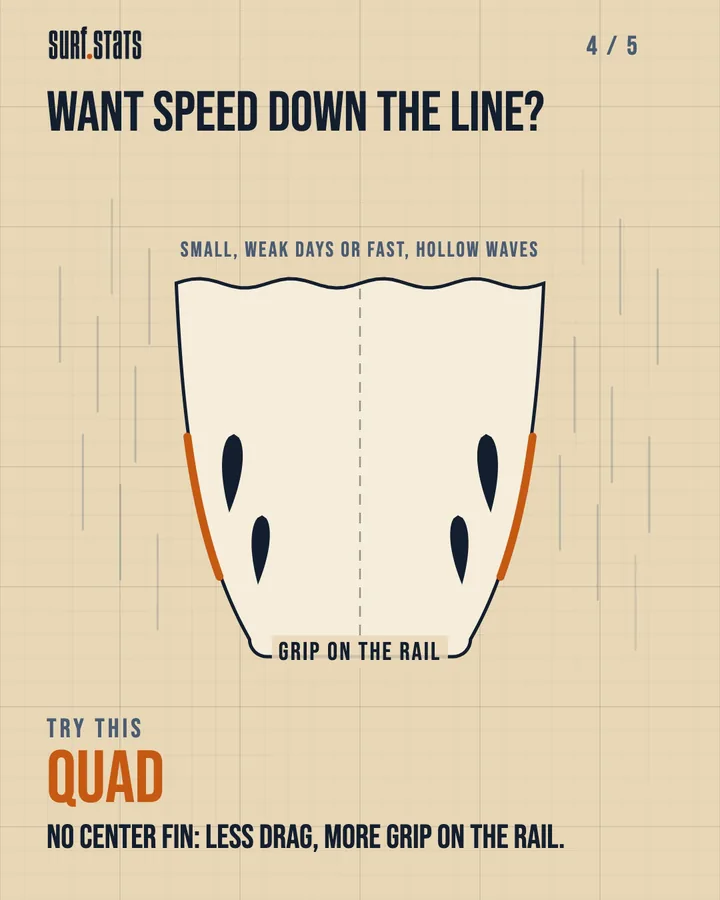
Try this: Quad. No center fin: less drag, more grip on the rail.
A quad has four fins, two on each side, and nothing in the center. The rear pair sits just behind the front pair, close to the rails. Surfer Today calls it an evolution of the twin, and it keeps a twin's loose feel but adds control.
With no center fin, a quad has less drag than a thruster. Fin makers and shapers describe the result as drive and speed, and Lost Surfboards' Matt Biolos says quads work like claws, holding the inside rail to a steep wall.
One trade-off, according to a shaper writing in Swellnet, is pivot: he says a quad lacks some of the pivot a thruster has. FCS rates a quad's control as moderate against the maximum of a thruster. Quads suit both ends of the scale: small, weak days that need extra speed, and fast, hollow waves.
5. Can't pick? Try five boxes
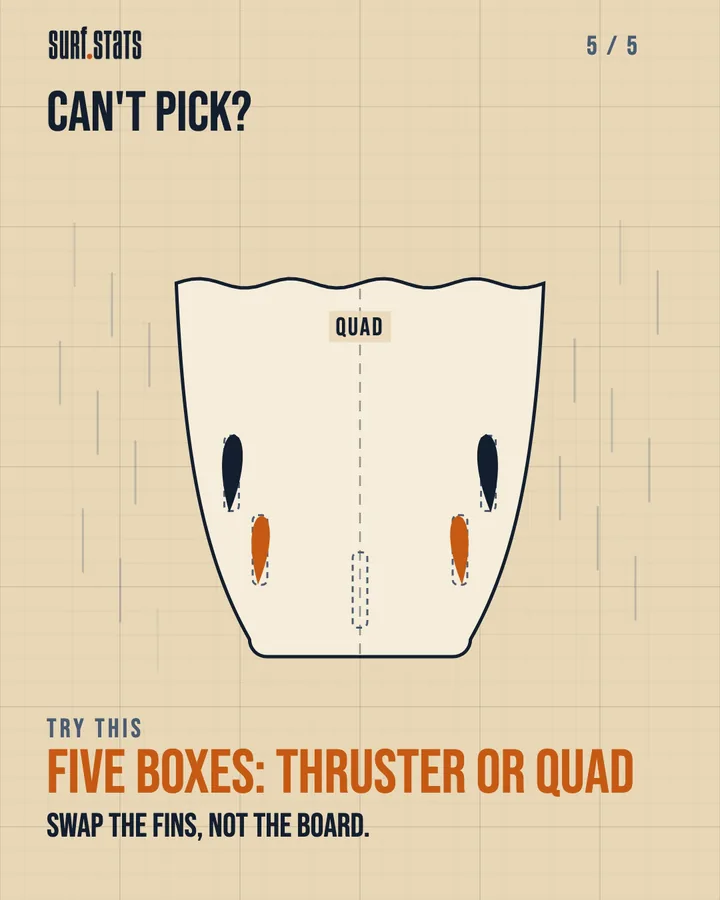
Try this: Five boxes: thruster or quad. Swap the fins, not the board.
A board with five fin boxes can be ridden as a thruster or as a quad. The front pair of fins stays the same in both. To go from thruster to quad, you take the center fin out and put the two rear fins in. FOAM's point is that you can change the setup without having to buy another board.
Not everyone is sold. Shaper Murray Bourton, writing in Swellnet, calls the five-fin set-up "nothing but a bet each way". FOAM and The Inertia both point to the flexibility as the upside. So try both, and judge for yourself which one your board likes.
Quick checklist
- Single fin: long, smooth lines. Quick, sharp turns are hard.
- Twin fin: loose and fast, fun in smaller waves. In bigger waves the tail can slide.
- Thruster: control in a wide range of waves. The center fin adds control, but also drag.
- Quad: speed down the line, less drag than a thruster, more grip on the rail.
- Five boxes: one board, ridden as a thruster or a quad. Swap the fins, not the board.
- Next, how the fins themselves are shaped: how surfboard fins work and the ultimate guide to surfboard fins.