
The ultimate guide to surfboard fins
Start with your board's fin boxes, pick a setup (a thruster is the usual first suggestion), then tune the feel with depth, base and rake. Size by your weight and check the fin system before you pay.
Choosing surfboard fins comes down to a few decisions, made in order. What fin boxes does your board have? Which setup do you want: single, twin, thruster or quad? Then which fin shape tunes the feel you're after, in what size, and in which fin system. This guide takes them one at a time and links to our deeper posts where we have them.
Every point is checked against independent sources: fin makers, board makers, surf press and fin research. Where they disagree, we say so instead of picking a side. Fins fine-tune a board. They don't replace a better board or better technique.
1. What do fins actually do?
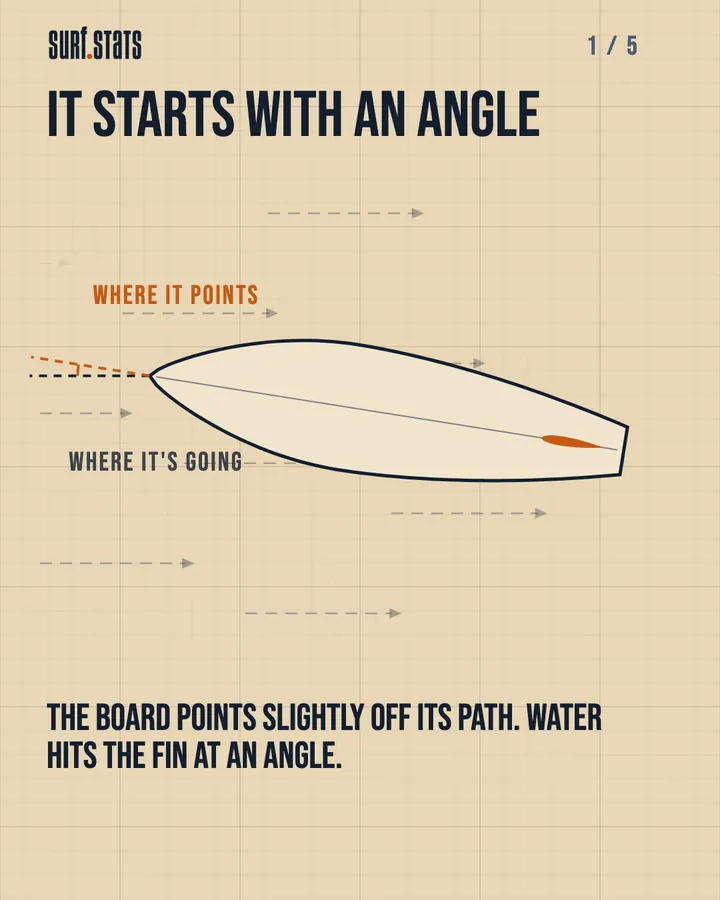
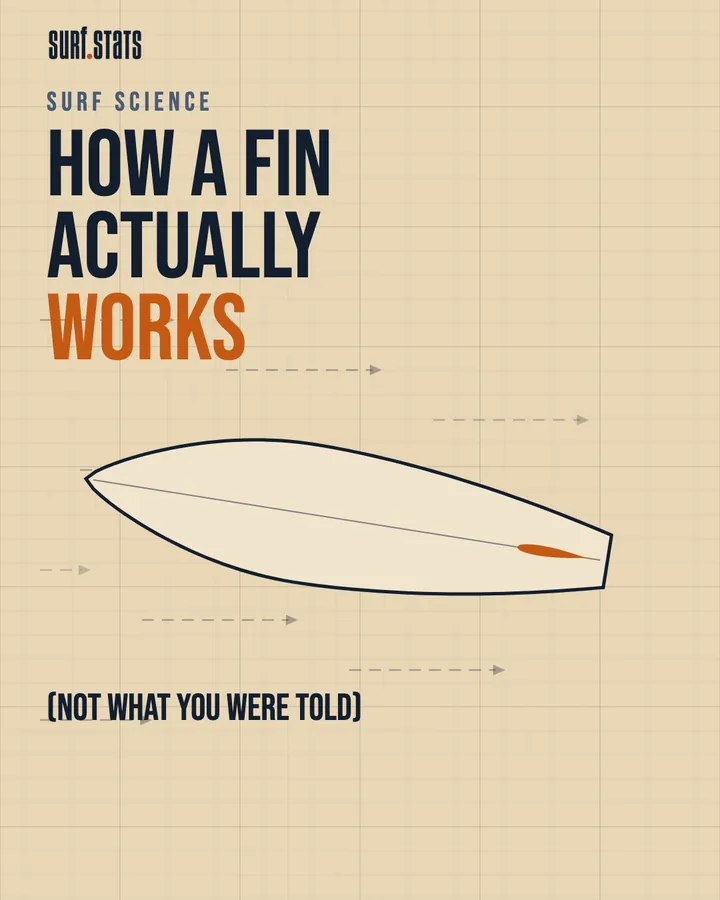
The short version: water hits the fin at a small angle and pushes sideways on it. That push is your hold, and in a turn it's your drive.
On its own, a fin doesn't push you forward. It gives you something to push against, so you can turn the speed you already have into a new direction. Push the angle too far and the water lets go of the fin. That's a spin-out. Treat "about 20°" as a ballpark: it comes from computer simulations of particular fins.
Hold and drive are one force with two names. The full story, plus the "water meets up at the back of the fin" myth, is in how surfboard fins work.
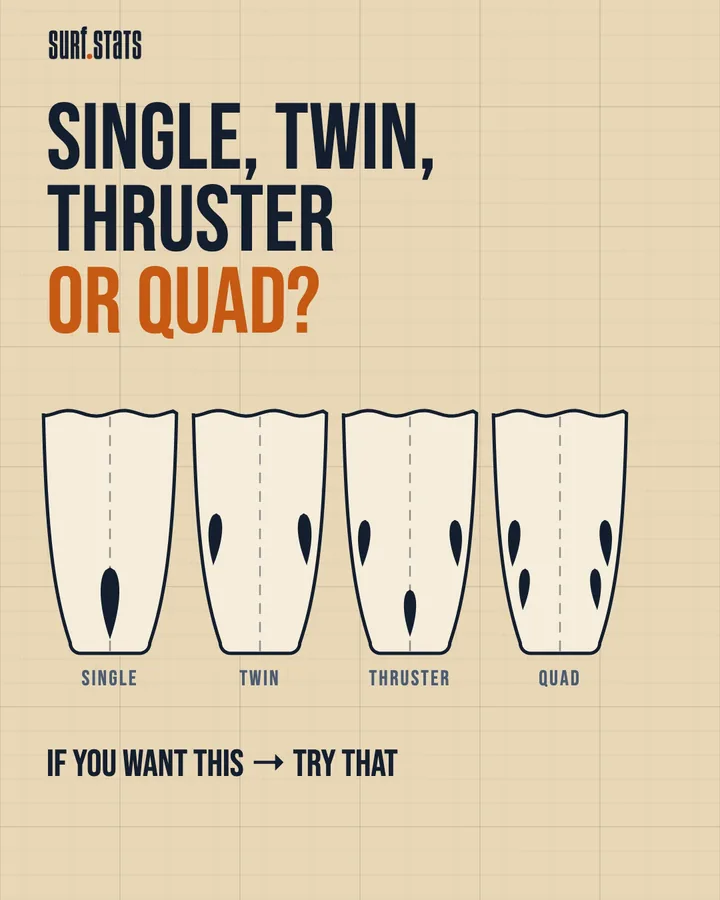
2. Single, twin, thruster or quad?
How many fins you ride, and where they sit, changes how the board feels. Each setup in full, with the sources, is in single vs twin vs thruster vs quad.
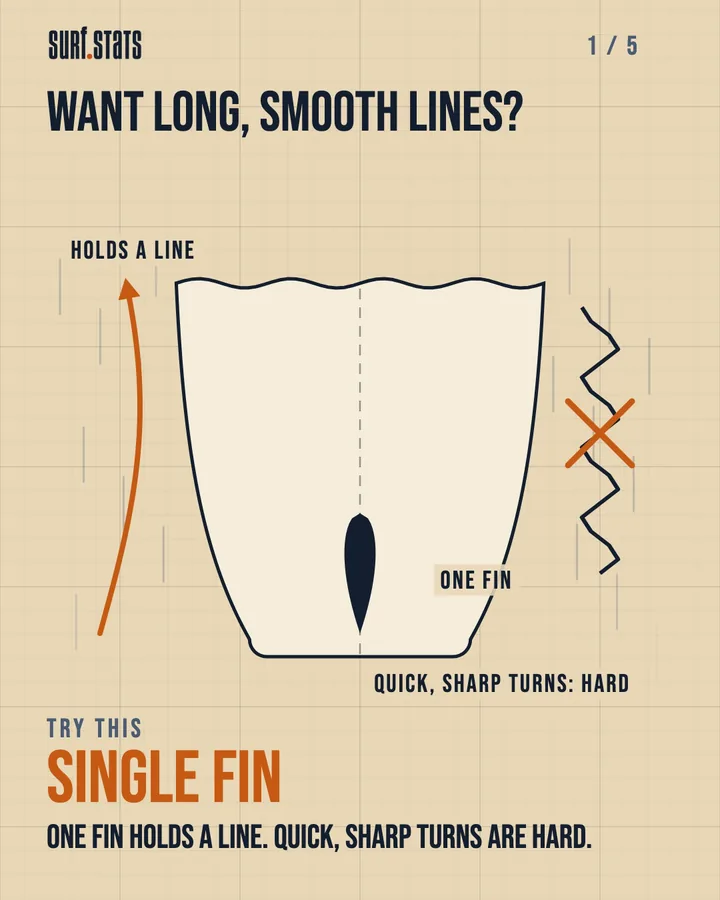
Single fin: the original setup. Today you mostly see it on longboards. It holds a line and draws out smooth turns, but quick, sharp turns are hard.
2+1: a longboard center fin plus two small side fins. It sits between a single fin and a thruster, and it's said to give single-fin smoothness with more control and drive. Watch the name: "2+1" is also used for a twin with a small trailer fin, so look at what a board actually has.
On a longboard, the single fin is the usual setup. Longboard singles sit in a longer box, and the fin slides forward and back. A single can skip out on bigger days, and side fins add hold.
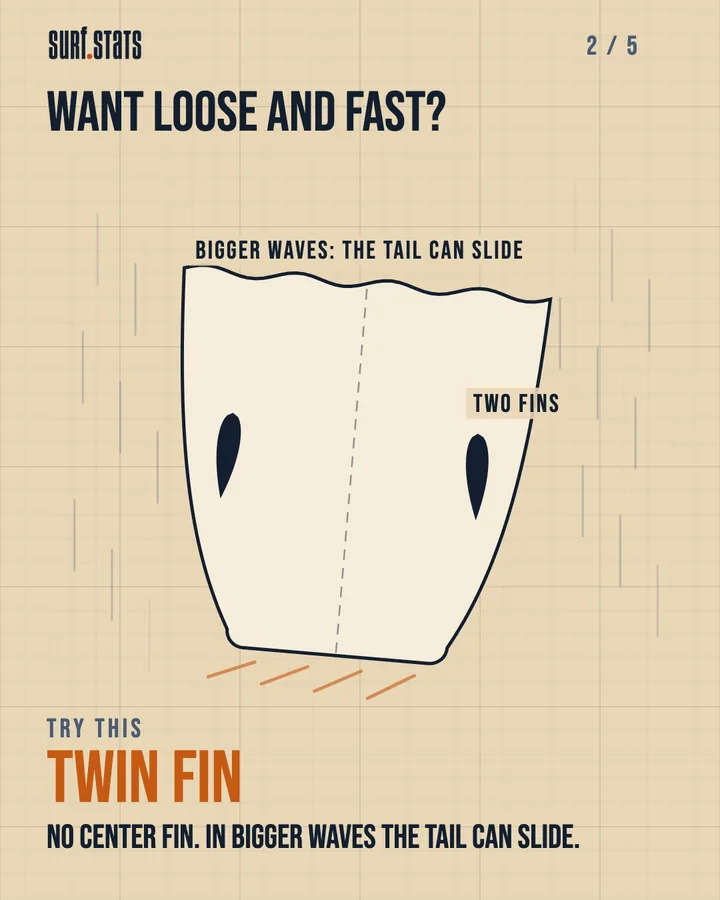
Twin fin: two fins, no center fin. Loose and fast, and fun in smaller waves. In bigger waves the tail can slide out.
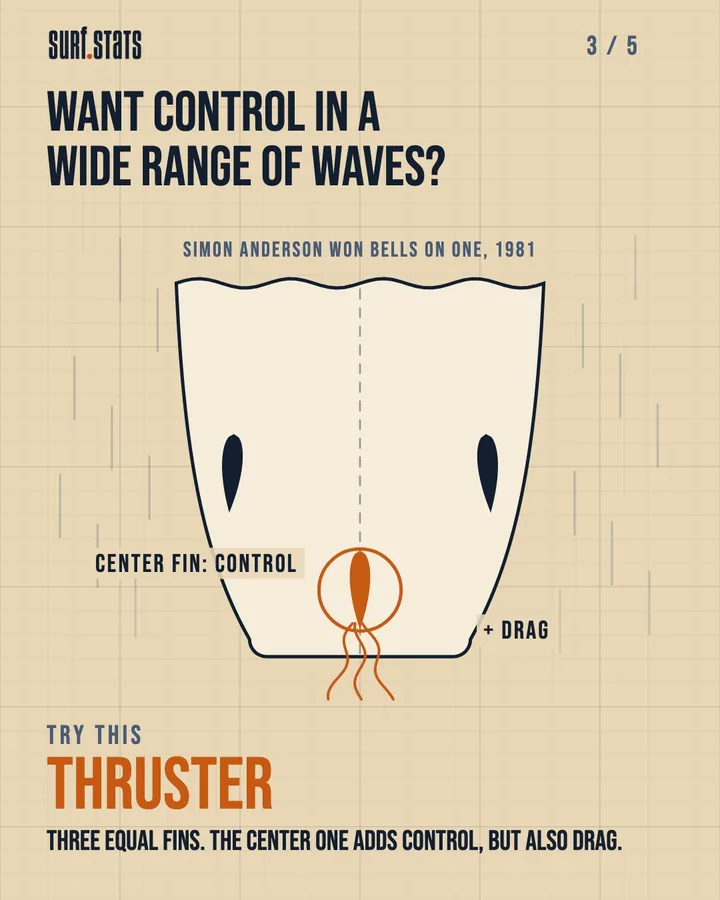
Thruster: two side fins and a center fin. The center fin adds control in a wide range of waves, and it also adds drag. Simon Anderson won Bells Beach on one in 1981.
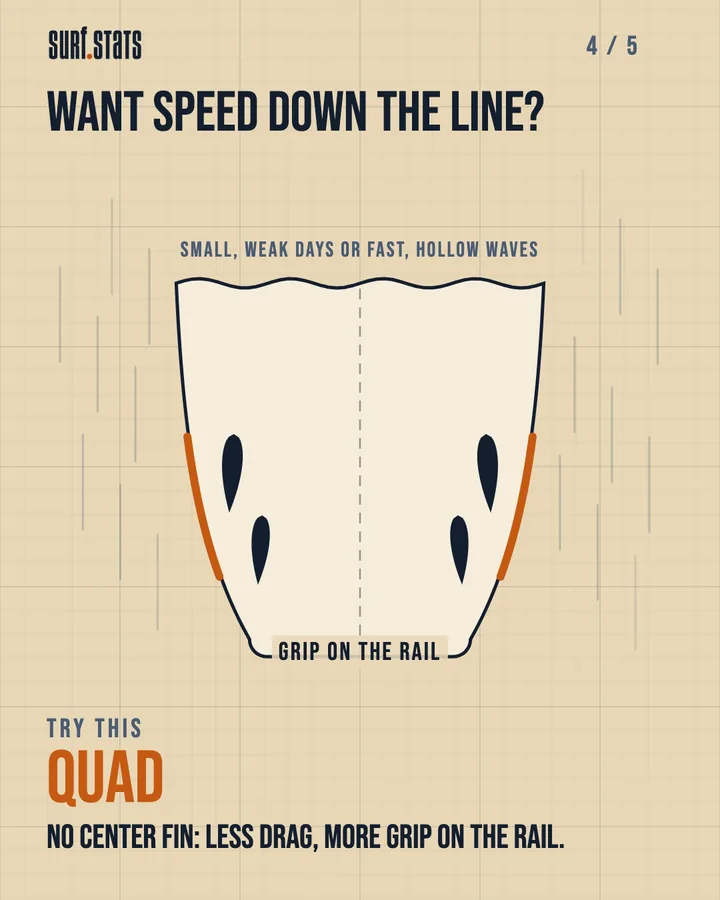
Quad: four fins, no center fin. Less drag than a thruster, and more grip on the rail. It suits small, weak days and fast, hollow walls.
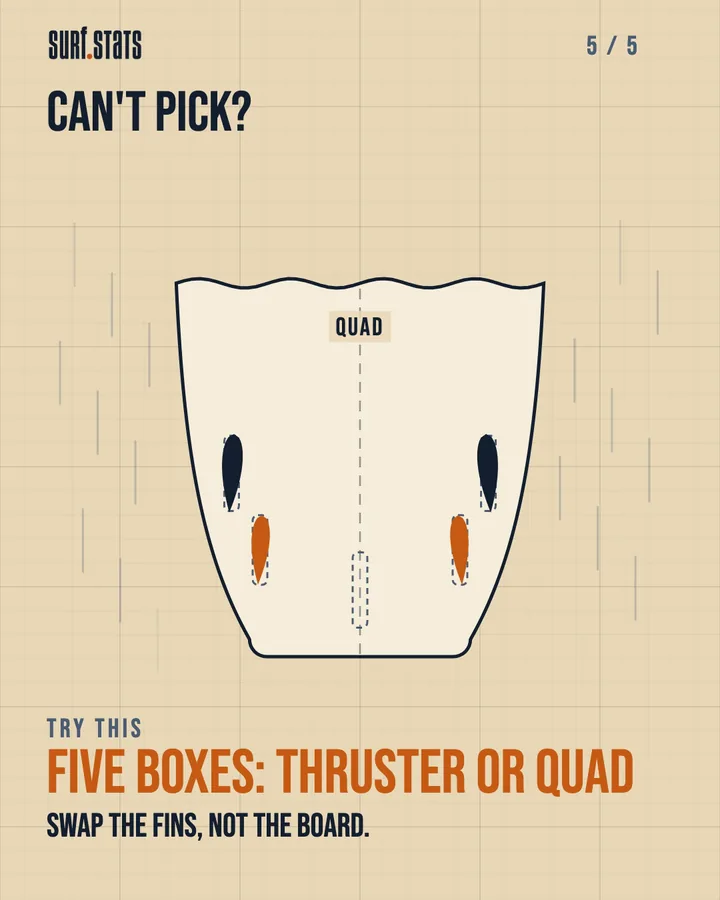
Five boxes: a thruster or a quad on one board. The front pair stays the same. Only the center fin comes out and the two rear fins go in, so you swap the fins, not the board.
Not sure which one is under your board? Look at its underside and count the fin boxes. They decide which fins fit (section 6). Starting out? A thruster, three fins, is the usual suggestion, and twins are harder to control.
3. Depth, base and rake: what the numbers on a fin mean
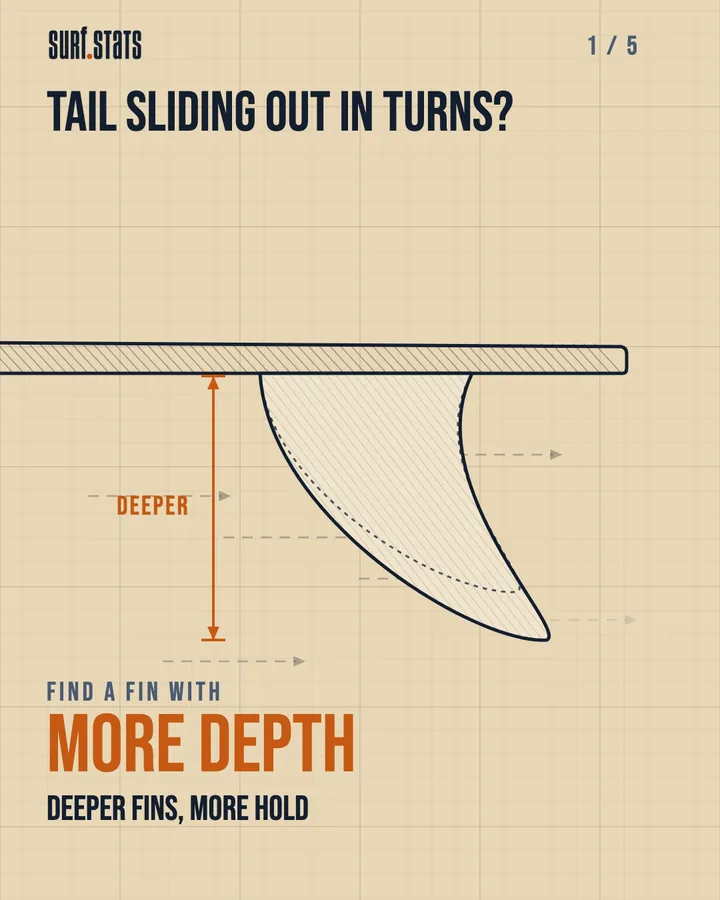
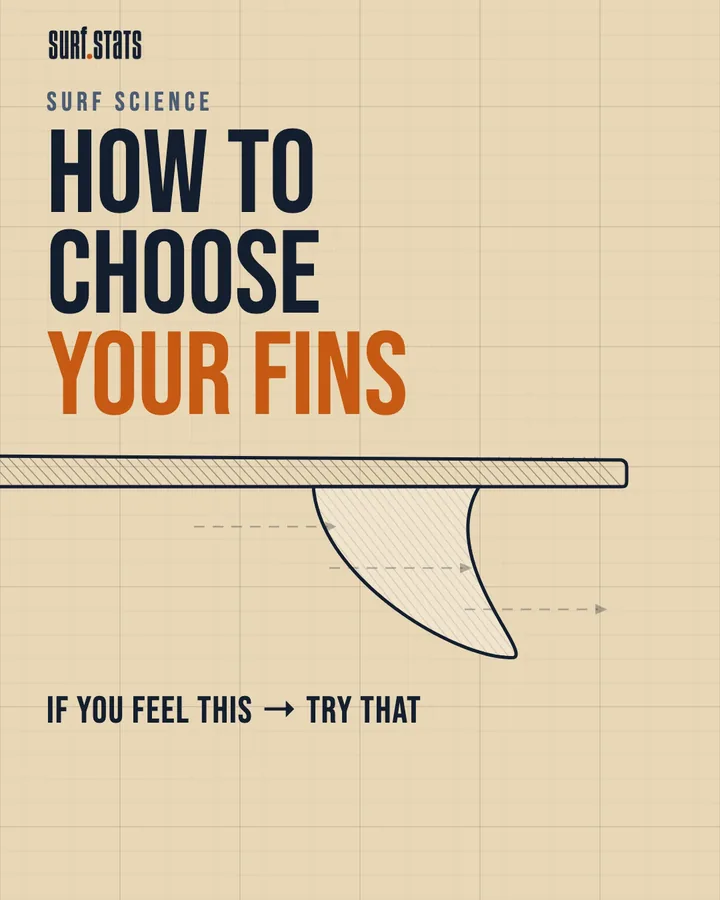
Fin spec sheets print three measurements, and fin makers agree on which way each one moves the feel. Depth is how far the fin reaches down from the board. Base is the length of the fin where it meets the board. Rake is how far the tip sweeps back behind the base.
- More depth: more hold. Less depth lets the tail slide and release.
- A longer base: more drive, which you feel as speed out of the bottom turn.
- Less rake (more upright): tighter turns. More rake: longer, drawn-out arcs, with more drag.
Three more terms show up on spec sheets, and this is where brand claims and tested facts come apart.
- Foil is the shape of the fin's cross-section. Side fins are usually flat on the inside and curved on the outside, center fins are symmetrical (50/50), and 80/20 and 70/30 foils sit in between and are used on quad rears. An inside foil has a scooped (concave) inside face and is said to add lift and cut drag. A foil makes lift, a sideways force, like a wing, and one pressure measurement on a fin in a river wave confirmed that force. We found no independent test of flat against inside foil against 50/50 for how a board feels, so what each one "does" is a brand claim.
- Cant is how far a fin leans outward from the board. Toe is the angle of the fin box relative to the stringer, set when the board is built. More cant and more toe are said to make a board looser and slower, while more upright, parallel fins are said to be faster but harder to turn.
- We found no study that varies cant or toe. The papers we read hold both fixed. Treat them as shaper and brand lore, not as numbers to chase.
Brands don't all use the same words. Depth is "height" at Futures, and rake is "sweep" at FCS. Start from what you feel, not from the model name: tail sliding out, try more depth; stiff and locked in, try less; no speed off the bottom means a longer base. The cheat sheet, with the sources behind every line, is in how to choose your fins.
4. Where the fins sit
Fins nearer the tail make the board stiffer, with more drive. Fins further up the board make it looser, easier to pivot, and give less drive. That rule holds for a single fin and for fins in general. Only a longboard's center fin slides in its box. Side fins and 2+1 side fins are fixed where the boxes were routed, so on most boards placement is chosen when you buy the board, not the fins.
5. Size and material
Size follows your weight. Fin sizes are set by rider weight: the heavier you are, the larger the fins should be. Use the brand's own size chart, because the charts differ from brand to brand. Don't carry a size from one brand to another.
Materials, in plain words. Plastic fins are the cheapest tier, and they're the ones that often come with a new board. Fiberglass, carbon and honeycomb fins cost more. A honeycomb fin has a lightweight hexagonal core. Fiberglass fins tend to be stiff.
What flex does to the way a board feels is a different story. Fin makers disagree on it, and we found no study that tests it on a surf fin. So we don't tell you to buy a fin for its flex. Start with the setup and the shape (sections 2 and 3).
6. Will they fit your board?
Check which fin boxes your board has before you buy fins.
Two systems dominate: FCS and Futures. Other boxes exist, but they're less common.
- FCS II: no screw and no key. The fin snaps in, with two small tabs that drop into two slots in the box.
- Futures: one long tab that slides into a single slot, held by a screw and a fin key.
- Glass-on fins are laminated into the board. They're rare today, and they can't come off for travel.
FCS and Futures use different boxes. Check yours before you buy. When a board maker chooses one box, the fins follow: Firewire announced in 2022 that it would make only Futures-compatible boards.
Putting them in and taking them out. FCS II goes in front first, then you press down until it clicks, and you lift it out by hand. Futures needs a key and a screw. Surftech notes that fin screws can rust or strip, and says to replace a worn one with a new screw.
Travelling. Take the fins out and pack them in a pouch or case. Leaving fins in can crack the fin boxes and smash the fins, and loose fins rattle around the bag and dig into your board.
Looking after them is simple: rinse after every surf, fins and fin boxes included. Check the screws and the fins for damage now and then.
7. Your first set
Starting out? A thruster, three fins, is the usual suggestion, and twins are harder to control. Check the box type, pick the size for your weight from the brand's chart, and know that plastic fins are the cheap entry tier. Start simple, and tune later with sections 3 and 4.
Buying checklist
- Count your fin boxes and note the system before you shop.
- Pick the setup first: single, twin, thruster or quad.
- Tune with depth, base and rake, from what you feel.
- Size by your weight, using the maker's chart.
- Fins fine-tune. Board and technique come first: how to choose a surfboard.
FAQ
What is a 2+1 fin setup?
A longboard center fin plus two small side fins. It sits between a single fin and a thruster, and it's said to give single-fin smoothness with more control and drive. The name is also used for a twin with a small trailer fin, so check what the board has.
What happens if I move my fin forward or back?
Closer to the tail, the board gets stiffer with more drive. Further up the board, it gets looser with less drive. Only a longboard center fin slides in its box.
What's the difference between flat, inside-foil and 50/50 fins?
Side fins are usually flat on the inside, center fins are 50/50 (symmetrical), and 80/20 and 70/30 foils sit in between. An inside foil has a scooped inside face and is said to add lift and cut drag. We found no independent test of which one feels better, so the claims for each are brand claims.
Do cant and toe matter?
They're said to change how loose and how fast a board feels, but no study we found varies either one. Treat them as shaper lore.
How do I install and remove my fins?
FCS II: front first, press down until it clicks, lift out by hand. Futures: a key and a screw.
Should I take my fins out when I travel?
Yes. Fins left in can crack the fin boxes and smash the fins. Pack them in a pouch or case, not loose in the bag.
Which fins fit my board?
It depends on the boxes. FCS and Futures are the two big systems and use different boxes, so check yours before you buy.
What should a beginner's first set be?
A thruster is the usual suggestion. Match the box type, pick the size for your weight, and keep it simple.