Why do waves come in sets?
 Fin Selector: your fins in 1 minute
Waves come in sets because lines of waves with slightly different lengths overlap. Where crests line up they add up to bigger set waves; where a crest meets a trough they partly cancel, and that's the lull. There's no fixed seventh wave, so time the sets at your spot.
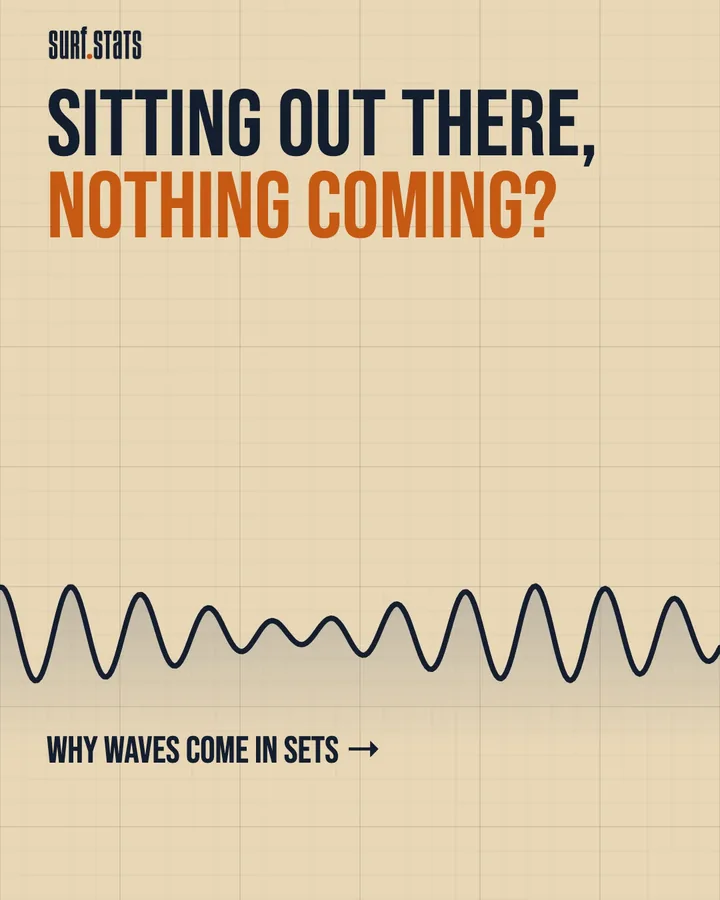
You're sitting out there and nothing is coming. Then a group of bigger waves rolls through, and after it, quiet again. That isn't bad luck. Waves come in sets, and the lull is part of the same pattern.
Below is why waves come in sets, what makes the lull, why the sets keep coming back, and what's true about the "seventh wave". It comes from our why waves come in sets reel, checked against national weather and ocean agencies (NOAA, Australia's Bureau of Meteorology), Surf Life Saving Australia, university oceanography courses and the Encyclopedia of Surfing.
1. Big waves together, then small ones?
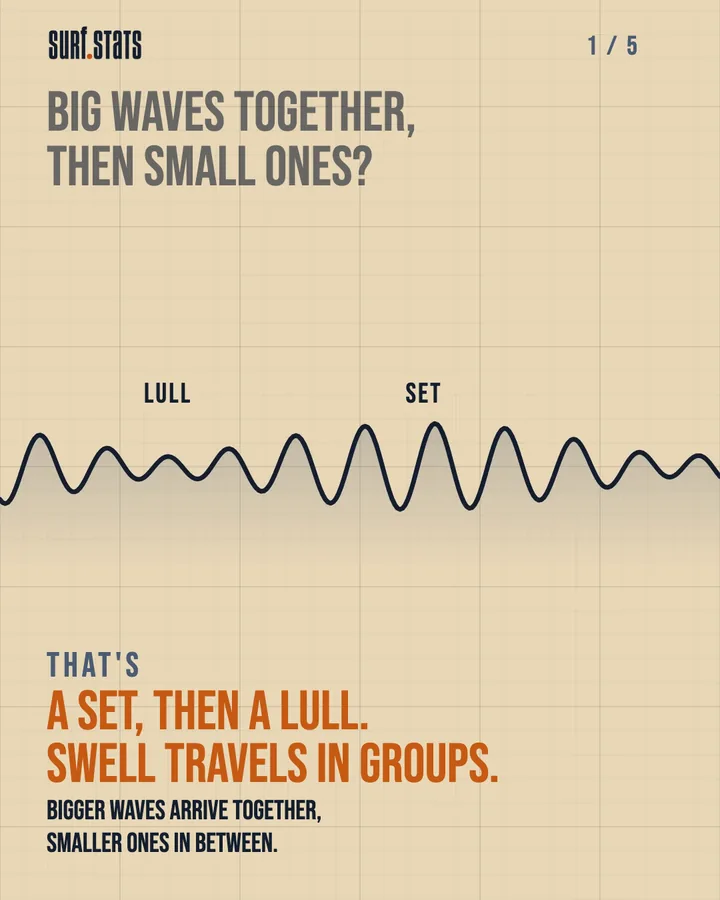
The short version: that's a set, then a lull. Swell travels in groups.
Swell doesn't cross the ocean as an even line of identical waves. It comes as bigger groups of waves and smaller ones. Surfers call the group of bigger waves a set, and the smaller waves in between the lull.
As swell travels, the waves tend to sort themselves into groups. So by the time it reaches your beach, the bigger waves tend to arrive together, with smaller ones in between.
Note the word "smaller". A lull is a stretch of smaller waves, not a flat sea.
2. Why are set waves bigger?
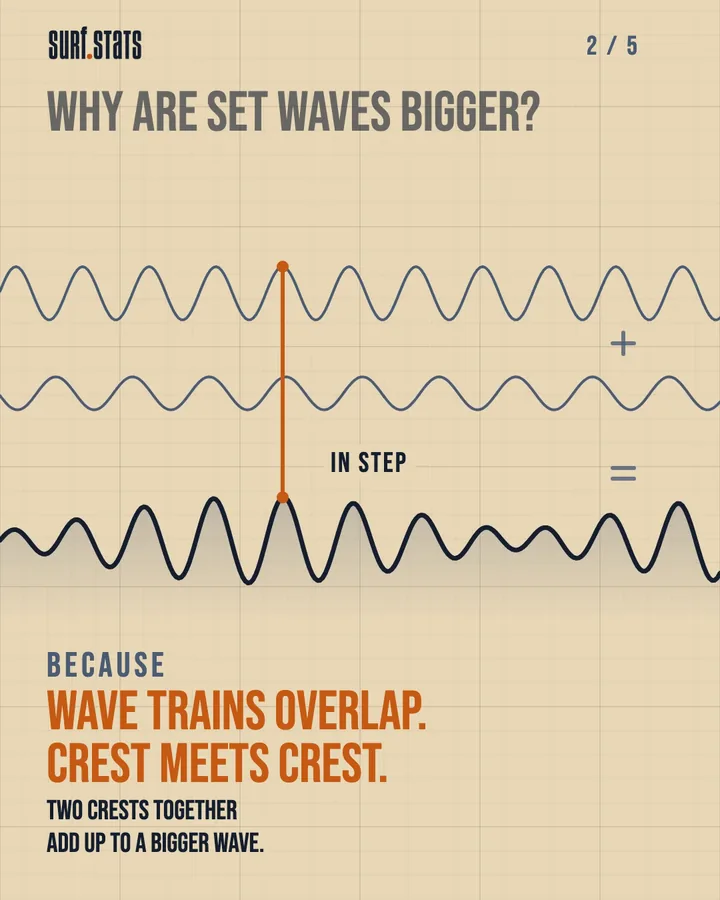
The short version: wave trains overlap. Crest meets crest.
A wave train is a line of waves of the same length. Out at sea there can be two or more of them at once, with slightly different lengths, and they overlap. Where the crest of one lines up with the crest of another, the two heights add up, and you get a bigger wave. A run of those is a set.
Those trains are sometimes from different storms, coming from different directions. But it doesn't take two storms: groups also form within a single swell.
3. Why does it go quiet?
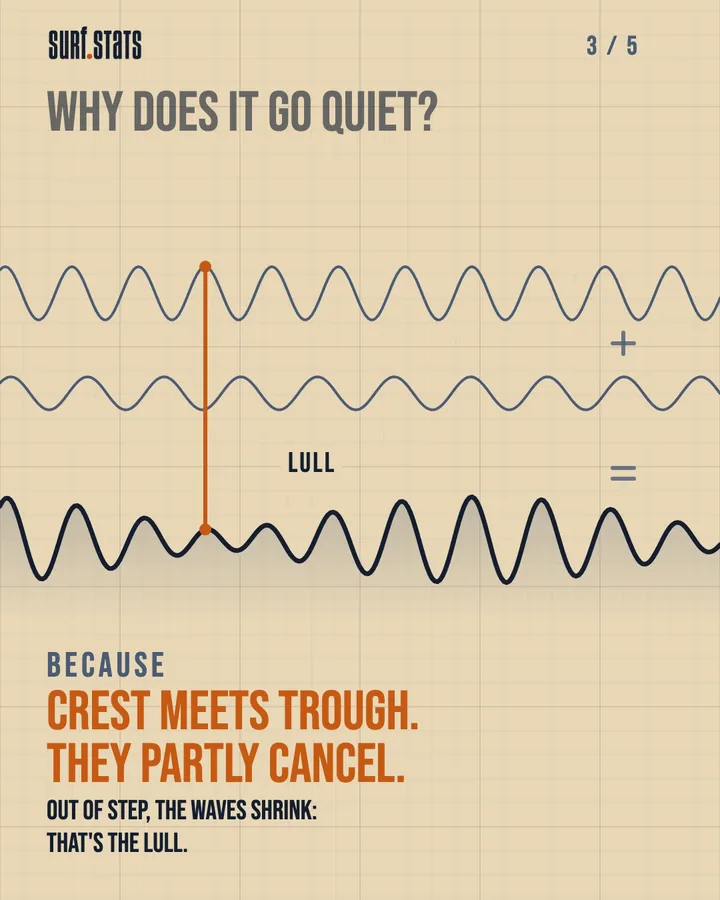
The short version: crest meets trough. They partly cancel.
Keep going along those same trains and they slip out of step. Now the crest of one meets the trough (the low point) of the other, and one takes away from the other. The result is a smaller wave. Out of step, the waves shrink: that's the lull.
They only cancel completely in the textbook case, where the two trains are exactly the same size. So a lull is smaller waves, not a dead-flat ocean.
4. Why do sets keep coming back?
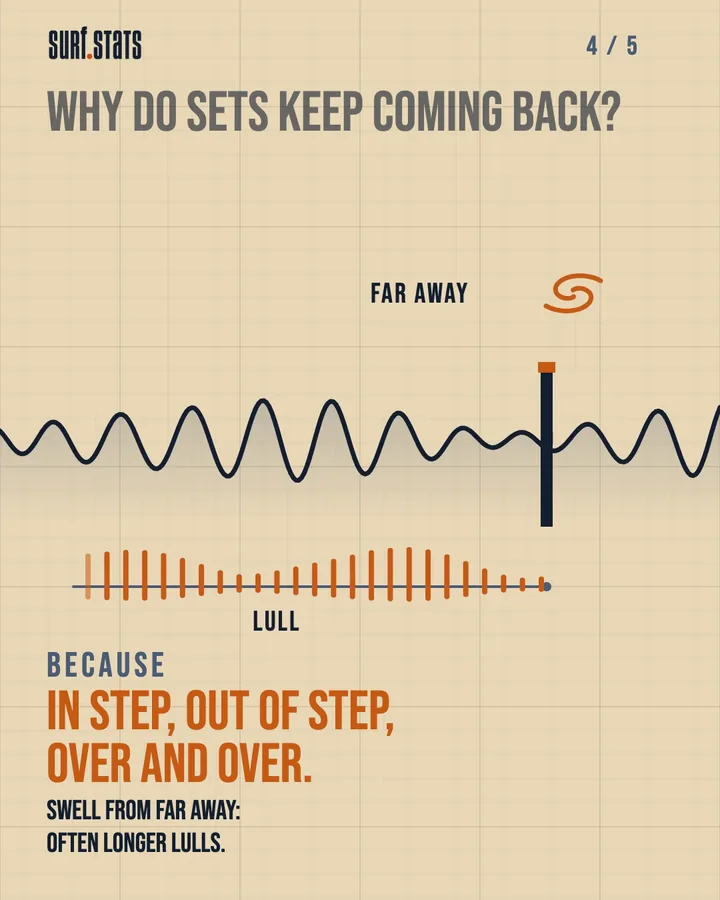
The short version: in step, out of step, over and over.
Because the trains have slightly different lengths, they keep drifting in and out of step. In step: a set. Out of step: a lull. Then in step again. That's why the sets come back instead of arriving once.
The wait varies. Sets can come every few minutes, or only every half hour or more. One clue is distance: swell from far away often brings longer lulls. "Often" matters there, because it's a tendency, not a rule.
Swell period is a different number: the seconds between single waves, not between sets. Our guide to swell period covers how to read it on a forecast.
5. Every seventh wave the biggest?
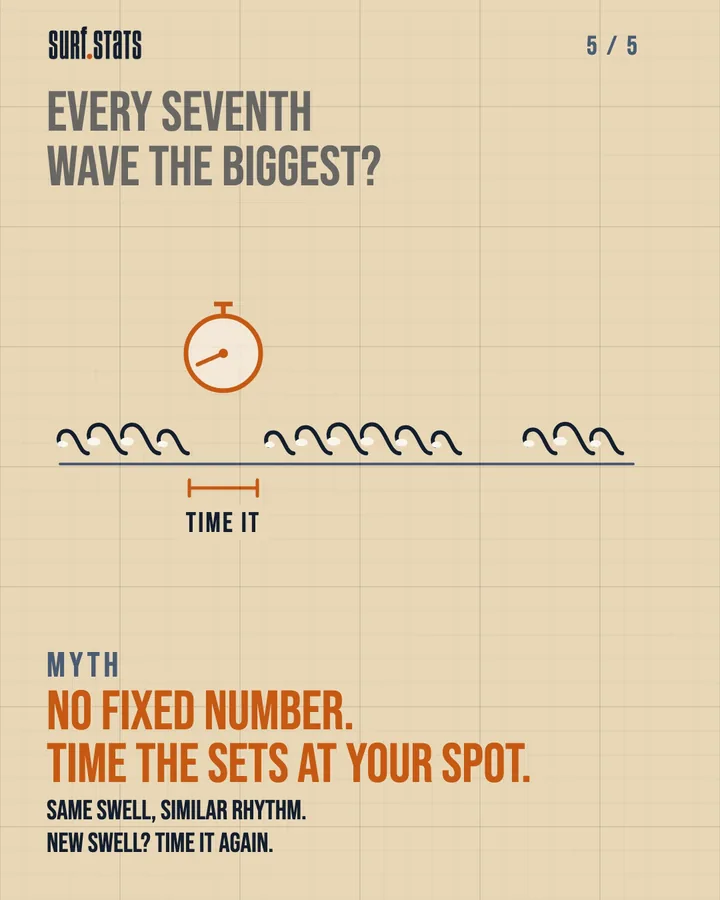
The short version: myth. There's no fixed number. Time the sets at your spot.
"Every seventh wave is the biggest" is an old belief, and as a fixed rule it doesn't hold. A NOAA weather service official, answering in Scientific American, said there's no evidence the number of waves in a group is anything but random, and Live Science calls the seven-wave rule basically false.
That doesn't mean seven never happens. NOAA's own history pages put it this way: as an average, seven is "not a bad guess, but definitely not a given." North Carolina Sea Grant gives the example of sets that come every third wave at one beach and every seventh at another. The number changes from swell to swell and from beach to beach.
So instead of counting to seven, time the gap between sets:
- Sit on the beach for a while before you paddle out and time how long the lulls last.
- Within one swell, the rhythm tends to stay similar for a while.
- When a new swell arrives, time it again.
The Encyclopedia of Surfing notes that surfers checking big days often do this, so they know roughly what they're paddling into. Surf Life Saving Australia's manual makes the same point for lifesavers heading out: timing the lull helps them avoid the bigger set waves.
Sets and lulls in one line
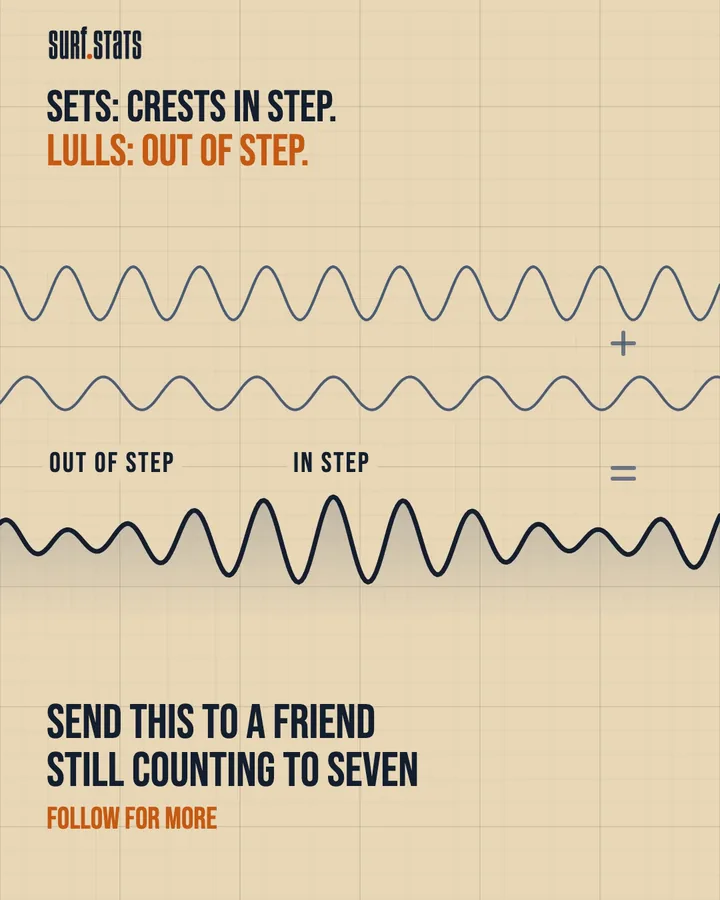
Sets: crests in step. Lulls: out of step.
That's the whole mechanism. Once you see the lull as half of the pattern, the quiet minutes make more sense. If you're planning when to go, our guide on how tides affect surfing is the next thing to check on the forecast.
Quick checklist
- Sets are the groups of bigger waves; lulls are the smaller waves in between.
- Set waves are bigger where crests of overlapping wave trains line up.
- Lulls happen where a crest meets a trough: the waves shrink, they don't vanish.
- The trains drift in and out of step, so sets keep coming back.
- Swell from far away often means longer lulls.
- No fixed seventh wave. Time the sets, and time them again when the swell changes.